Slab Leak Repair: What to Expect Once the Leak Is Found
Finding a slab leak is only the first half of the job. Once detection confirms water escaping beneath the concrete floor, the next question is what happens next. Slab leak repair is not one fixed procedure: the right fix depends on where the pipe failed, what the pipe is made of, and how the home was built.
- Practical homeowner guides
- Written by leak detection pros
- Sun City, AZ focused
First, the Repair Plan Is Mapped Out
A repair never starts with a jackhammer. It starts with the detection report: the exact location of the leak, how deep the pipe sits, whether the line carries hot or cold water, and what material the pipe is. A good technician walks the homeowner through that report before any work begins, because the location often decides the method. A leak under an open floor is a different job from one under a kitchen island, and the plan has to fit the house.
At this stage, expect questions about the home itself: the age of the plumbing, whether any sections have been replaced before, and whether there have been earlier slab leaks. A home with two earlier leaks in the same pipe run is a different conversation from a home with its first, and the repair choice should reflect that. Our guide to the signs of a slab leak explains how these leaks are spotted — the repair plan builds directly on what detection found.
The Common Repair Routes
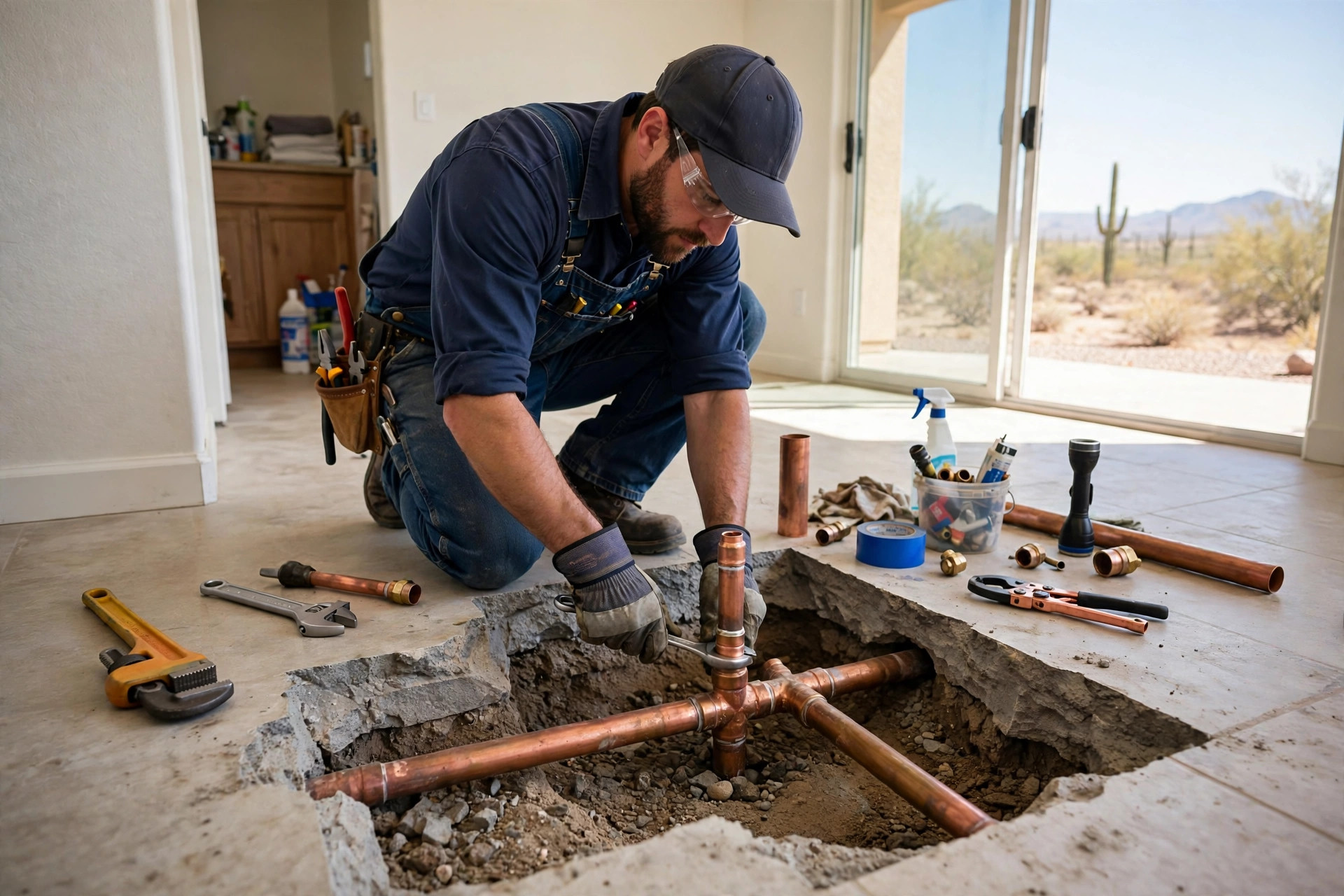
There are three broad ways to fix a slab leak, and each suits a different situation. A spot repair opens the floor at the leak, cuts out the failed section, and joins in a new piece — the most direct fix when the rest of the pipe is sound and the leak is reachable. A reroute leaves the failed pipe in place and runs a new line around it — through walls or the ceiling — so the floor never has to be opened at all. And a full repipe replaces the home's water lines entirely, which is usually reserved for older systems where leaks keep returning.
None of these is automatically the best choice. A spot repair is the smallest job, but it makes little sense if the pipe is failing in several places, and a reroute avoids floor work at the cost of new pipe through finished rooms. The honest answer depends on the pipe's condition, the leak's location, and how often the system has already failed — which is why a plan that skips the options deserves a second opinion. Professional slab leak detection pinpoints the failure precisely enough for a real discussion, instead of a guess.
What the Work Looks Like Inside Your Home
Homeowners worry most about the mess, and it is fair to ask exactly what will be moved, cut, and dusted. For a spot repair, the work area is usually a single section of flooring, protected with sheeting, with furniture moved aside. Cutting is loud and dusty, but confined to the marked area, and rubble is cleared as the work goes on. For a reroute, the disruption moves to walls and ceilings instead: small openings where the new line passes, patched and finished once the pipe is in.
Water is shut off during the work itself, then restored for testing before anything is closed up. That test matters: the new joint or line is pressurised and checked before anything is restored, because reopening finished work is what everyone wants to avoid. Ask how the finished surface will be left, so there are no surprises after the plumber leaves.
How Long the Work Takes — and What Follows
Most single-leak repairs are measured in hours to a day of active work, with drying and finishing time on top. A reroute can take longer because the new line has to be threaded through the house and every connection tested. Afterwards the floor or wall is restored, the area dried, and the water meter checked over the following days to confirm the system holds steady. A meter still spinning with every tap closed means the job is not finished.
Keep the detection report and repair notes together: if another leak appears, the next technician will want to know which pipe was replaced, where, and with what material. Homes across the West Valley, including Surprise, share the same slab construction and hard-water wear.
Why the Right Repair Depends on the Pipe
Copper, PEX, and older galvanised pipe fail in different ways, and the repair should match the material. Copper in Sun City's mineral-rich water can develop pinhole leaks from the inside, so one visible hole can be the first of several, and a spot repair on a thinning copper line may only buy time. PEX rarely fails along its length; its weak points are the fittings, and a failed fitting is usually a clean, lasting fix.
That is the real value of detection before repair: it turns a hidden problem into a known one, with a location, a material, and a history, so the repair decision follows from facts instead of opening the floor and hoping. If you are still wondering whether a leak is even there, our FAQ page explains how a detection visit works and what it can confirm.
Frequently Asked Questions
Does slab leak repair always mean breaking the floor?
No. A spot repair opens the floor at the leak, but a reroute runs a new line through walls or the ceiling instead, leaving the slab untouched.
Can I stay in the house during a slab leak repair?
Usually yes. Water is shut off only while the repair is being made, and restored for testing the same day. Ask in advance so you can plan around the shutoff window.
Will the leak come back in the same spot?
A properly repaired section should not fail again at the same joint. But if the pipe is thinning along its length — common with older copper in hard water — a new leak can appear nearby.
How do I know the repair actually worked?
The new pipe is pressure-tested before anything is closed up, and the water meter should sit still with every tap closed. Check it again over the following days — steady readings confirm the system is holding.
Slab Leak Found?
Know where it is — now get a repair plan that fits the pipe, the location, and the house.
(623) 270-6035 Request a Quote