Winter Pipe Freeze Protection for Desert Homes: A Sun City, AZ Guide
Desert winter nights can drop below freezing — and uninsulated pipes on Arizona homes freeze fast. Here's how to protect yours before the first cold snap, and what to do if a pipe freezes anyway.
- Practical homeowner guides
- Written by leak detection pros
- Sun City, AZ focused
Yes, Desert Homes Get Frozen Pipes
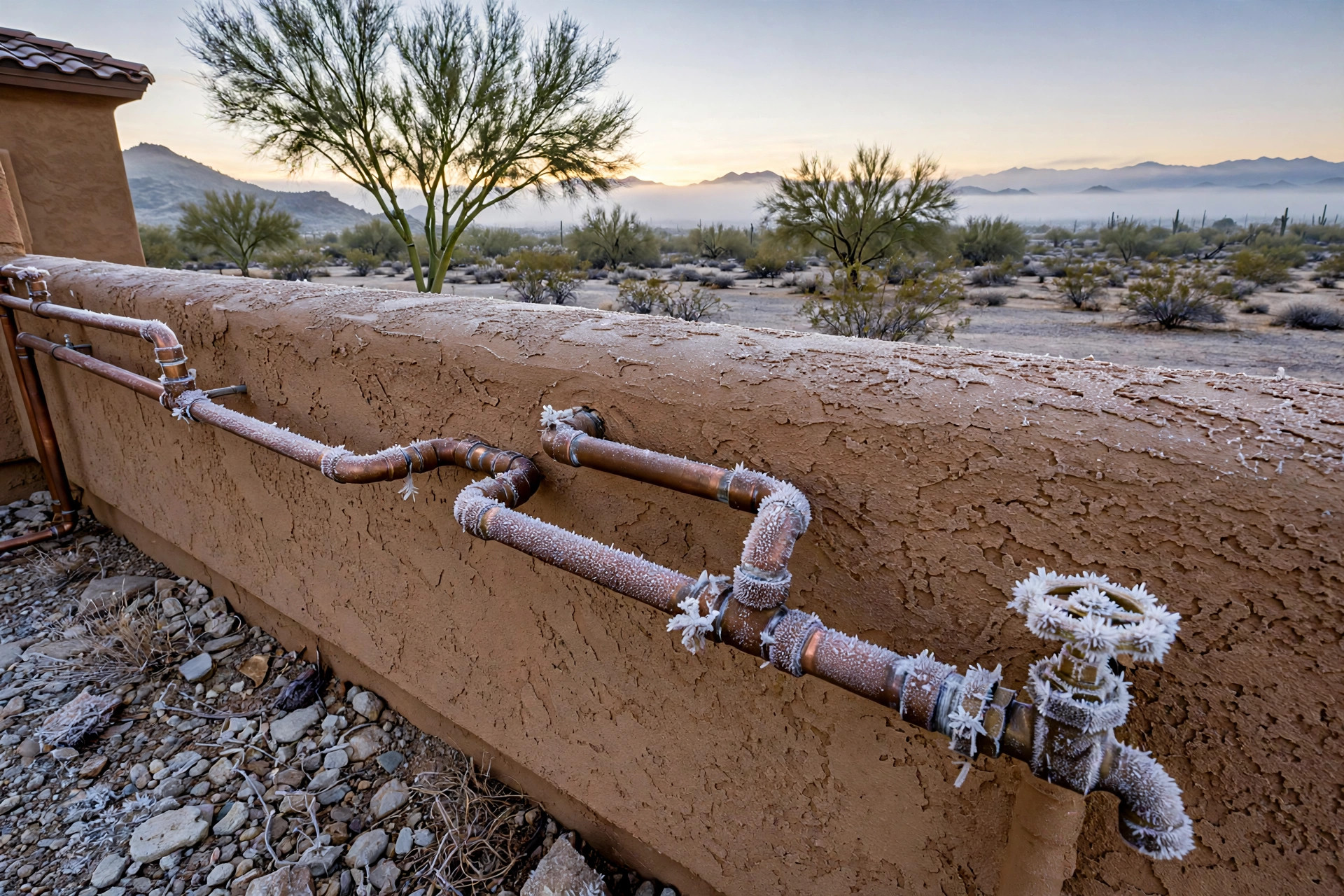
It surprises newcomers every year: Arizona homes get frozen pipes. From December through February, Sun City nights regularly drop below freezing, and the coldest snaps can sit under 32°F for six or more hours. Desert homes are actually more vulnerable than houses in cold climates, because builders here never wrap pipes against deep cold — exposed copper and PVC runs along exterior walls, in attics, and under eaves are sitting targets. One hard overnight freeze is enough to crack a pipe. The good news: freeze protection is one of the cheapest winter chores you'll do all year, and it takes an afternoon, not a contractor.
The Pipes Most at Risk in Sun City
Walk around your house and you'll see the danger zones. The biggest risk is any water line running along an exterior wall with no insulation: outdoor hose bibs and spigots, pipes in the garage, lines under sinks on north-facing walls, exposed copper at the water heater or softener, and irrigation and pool plumbing. Pipes in unheated attics and crawl spaces are close behind. Copper freezes faster than PEX, but any pressurized line can burst once ice forms — water expands as it freezes, and that pressure has to go somewhere.
Insulate Exposed Pipes Before the First Cold Snap
The single best protection is foam pipe insulation: the pre-slit black or gray tubes sold at every hardware store. Measure the pipe diameter, buy the matching sleeves, press them onto any exposed pipe run, and tape the seams and joints. Pay special attention to elbows and valves, which are the first things to freeze, and seal the insulation with duct tape so it doesn't gap open in wind. For the coldest nights, you can add a second layer or cover the sleeve with an old towel under a secured plastic bag. Do this in November, while afternoons are still comfortable — nobody enjoys insulating pipes with numb fingers in January.
Protect Outdoor Faucets and Hose Bibs
Hose bibs are the number-one burst point in Arizona freezes. Start by disconnecting every garden hose — a connected hose traps water in the faucet and guarantees ice forms right at the valve. Then drain the faucet and screw on an insulated faucet cover. If you have a shutoff valve for an exterior line inside the garage or house, close it for the winter and open the outside faucet to drain. Vacuum breakers and backflow preventers on irrigation lines deserve covers too — they're plastic, they crack easily, and replacements are a headache you'd rather skip.
Let Faucets Drip on Hard-Freeze Nights
When the forecast calls for a hard freeze — below 28°F, or a long stretch at or below freezing — a slow drip is cheap insurance. Open the faucet farthest from where water enters the house to a thin, steady pencil-width stream, and do the same for any faucet on an exterior wall. Moving water is much harder to freeze, and the open faucet gives expanding ice somewhere to relieve pressure. On a single-handle faucet, run both the hot and cold lines. Yes, you'll use a little water — a fraction of what one burst pipe would spill into your wall.
What to Do If a Pipe Freezes Anyway
You'll know: the faucet barely trickles or nothing comes out at all while the rest of the house has water. First, open the affected faucet to relieve pressure. Then warm the frozen section gently — a hair dryer on low, a heating pad, or warm (not boiling) wet towels, working from the faucet back toward the frozen area. Never use an open flame; you can scorch the pipe or start a fire. If you can't find the frozen section, or water starts leaking anywhere during the thaw, close the main shutoff valve immediately.
When a Freeze Turns Into a Leak
A frozen pipe that cracks may not leak until it thaws — which means the damage often shows up hours or days after the cold night, when you're not watching for it. After any freeze, walk the house and check for hissing sounds in walls, water stains on ceilings and baseboards, a musty smell, or a water meter that spins when everything is off. If you suspect the thaw opened a leak somewhere, the water meter test is the fastest way to confirm it before you start opening walls. When the break is hidden, professional water leak detection pinpoints it acoustically so the repair stays surgical instead of destructive.
Frequently Asked Questions
Do pipes really freeze in Sun City, AZ?
Yes. Sun City winter nights regularly dip below freezing from December through February, and exposed copper and PVC lines on exterior walls freeze faster than pipes in colder climates because desert homes often leave them uninsulated. It only takes a few hours below 32°F for an exposed pipe to freeze.
What temperature should I start worrying about?
Take action when the forecast calls for 32°F or below overnight. Hard freezes — below 28°F for several hours — are when bursts happen. Even a single night a few degrees below freezing can crack an unprotected pipe, especially if wind is blowing against the house.
Should I drip indoor or outdoor faucets?
Drip the faucet farthest from where water enters the house, plus any faucet on an exterior wall. A thin, steady pencil-width stream is enough — both hot and cold lines on a single-handle faucet. Turn off the drip lines once temperatures rise back above freezing.
A pipe froze and now I hear hissing in the wall — what does that mean?
Hissing after a freeze-thaw cycle is a strong sign the pipe cracked and water is spraying inside the wall or ceiling. Shut the main water valve off immediately and call for professional leak detection — the break needs to be pinpointed before any repair begins.
Freeze Night Left You With a Suspicious Drip?
After a thaw, a hidden crack is hard to find on your own. Call for a precise, non-invasive diagnosis.
(623) 270-6035 Request a Quote